AMD GPU Runs DLSS 5 at 119 FPS Thanks to Async Trick
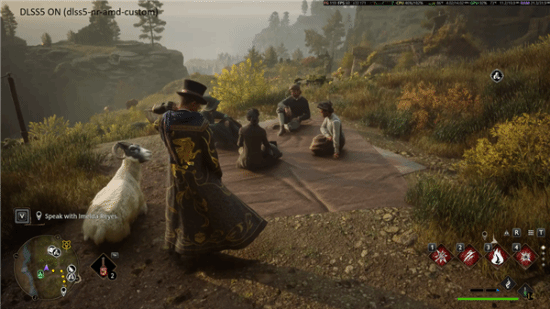
A developer got DLSS 5's neural network running on an AMD RDNA 3 card, boosting frame rates from a rough 20 FPS to a smooth 119 FPS using an async approach.
Bet you never thought you'd see DLSS running on a red team card. Well, one clever developer just made it happen — and the numbers are wild.
A tech tinkerer going by RedDukeDev has dropped an experimental open-source project that gets DLSS 5's neural network model running on AMD graphics cards. The kicker? It takes performance from a basically unplayable 20 FPS all the way up to 119 FPS.
Here's the problem the project had to solve. DLSS 5's reconstruction work is seriously heavy, and third-party GPUs like AMD's don't have dedicated Tensor Cores. Without that specialized hardware, the neural network module introduces some pretty painful processing latency.
If you go with the standard synchronous approach — where every single frame has to wait for the neural network to finish its calculations — performance tanks to a level most of us would call unplayable. To prove the point, the developer ran a benchmark on an RDNA 3 card at 1440p, with ray tracing off and FSR 4 upscaling plus frame generation turned on.
The baseline scene was pumping out around 139 FPS. Switch to synchronous neural network computation, though, and it crashes down to roughly 20 FPS. Yeah, that's rough.
The async method flips the script. Instead of making the display pipeline sit around waiting, the neural network's output gets processed the moment it's ready. The system calculates the residual between the network's input and output, then applies the result to the current frame using a displacement map. That way, the display pipeline never has to pause, and frame rates hold steady at 119 FPS — keeping most of that original smoothness intact.
It's not all sunshine, though. The approach still has some clear limitations right now. In dynamic scenes, you'll spot visual artifacts, and they get worse the bigger the time gap between rendering and neural network computation, especially with frame generation enabled. In static scenes, though, the distortion is basically nonexistent.
The developer is already working on adding various optimization algorithms to cut down on ghosting, and has confirmed the tool plays nicely with Linux and the Proton compatibility layer. Not bad for an experimental side project — and a pretty interesting peek at what's possible when you get creative with hardware that wasn't built for the job.
Would you risk a few artifacts to run DLSS on an AMD card? Let us know what you think.
📰 Related Articles
P.T. Is Coming Back to PC Thanks to One Fan's Reverse-Engine…
若順利推出,玩家將能在現代 PC 上以更高畫質與幀率重溫這款已無法合法取得的恐怖經典。
Quantic Dream Thanks Fan Who Turned Detroit: Become Human Into a 6-Hour DLSS 5 Movie
A Chinese content creator used DLSS 5 to recut Detroit: Become Human into a nearly six-hour cinematic experience, and Quantic Dream itself showed up to say thanks.
Resident Evil Requiem's Title Just Got More Confusing, Thanks to Producer
Producer Jun Takeuchi explains that 'Requiem' contains both an answer and a question, and hints at a future crossover between remakes and numbered titles.
GTA 5 Switch Mod Shut Down by Take-Two, Dev Thanks 'Mercy'
A mod project to bring GTA 5 to Switch is cancelled after a cease-and-desist from Take-Two. The developer thanks the company for its 'mercy' and says he won't release the code.
Kingdom Come: Deliverance 2 Just Got Multiplayer Thanks to a Mod
A new mod brings multiplayer to Kingdom Come: Deliverance 2, letting you share its medieval open world with friends instead of going it alone.
AMD GPUs Get 74% DLSS 5 Boost in One Day, Thanks to This Modder
A third-party tool now lets AMD Radeon cards run Nvidia's DLSS 5 neural rendering, delivering a massive 74% performance jump in a single day.