Nvidia GPU Prices More Than Double as AMD and Intel Win on Value
A new 3DCenter roundup shows Nvidia cards now trail AMD and Intel on price-to-performance, with RTX 5090 prices up over 132% in a year.
If you're building a PC right now, your wallet is probably crying. RAM and SSDs have been climbing all year, and GPUs are getting pricier and harder to find too. That makes picking between AMD, Nvidia, and Intel messier than ever.
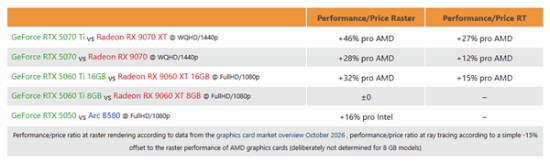
Thankfully, 3DCenter put together a value breakdown of the current mainstream cards from all three vendors, and it's a handy reference if you're stuck on what to buy. Their math weighs both traditional raster gaming performance and ray tracing performance, so there are two ways to read the value picture.
At the 2K resolution tier, the RTX 5070 Ti versus RX 9070 XT matchup is rough for Team Green. AMD's card lands 46% better value in raster games, and it still comes out 27% ahead in ray tracing value. The RTX 5070 versus RX 9070 comparison tells a similar story, just less dramatic, with AMD ahead by 28% and 12% respectively.
Move down to the RTX 5060 Ti versus RX 9060 XT, and the 16GB models still favor AMD on value. The 8GB versions flip that, though. At the very low end, AMD doesn't really have a horse in the race, since the RX 9050 doesn't appear to have a meaningful retail presence. That leaves Intel's B580 holding the line, still delivering a 16% raster value advantage.
So why is Nvidia suddenly the value loser? Blame the price hikes, which have been far steeper on Team Green over the past year. The RTX 5090 jumped from 2600-2900 euros to 6000-6800 euros, a rise of over 132%. Other RTX 50-series cards climbed 50-70% overall. AMD and Intel raised prices too, but nowhere near as hard. On average, Nvidia went up 66%, AMD 46%, and Intel 38%.
That said, value isn't the whole story. Nvidia cards are still selling out at those inflated prices, which tells you plenty of buyers aren't chasing price-to-performance at all. Ray tracing, DLSS, and AI features give Team Green a combination AMD and Intel can't fully match right now, and that's a big part of why their cards can't command the same premiums.
At the end of the day, your budget and what you actually play matter more than any value chart. If you mostly game and want the best bang for your buck, AMD and Intel look awfully tempting. If ray tracing and DLSS are must-haves, Nvidia still has a case. What are you leaning toward for your next upgrade?
📰 Related Articles
What the Nvidia SSD Driver Bug Means for Your PC
Players with Nvidia GPUs may need to be cautious about installing the latest drivers until a working fix is released, as excessive SSD writes could degrade drive performance over time.
Nvidia's Driver Bug: What It Means for Your SSD and How to P…
This bug causes unnecessary wear on SSDs, potentially reducing their lifespan, and forces users to either revert to an older driver or apply a workaround, highlighting the importance of monitoring sys…
Did November's NVIDIA Driver Update Wear Out Your SSD? Here'…
Players on affected drivers should manually install the hotfix to stop excessive SSD writes, while a permanent fix remains pending.
Is Your SSD Dying? NVIDIA's Latest Drivers Might Be the Caus…
The bug can significantly reduce SSD lifespan due to excessive writes, forcing users to choose between driver rollback and losing features like G-Sync.
NVIDIA RTX Spark Compact Desktops Launch: Local AI Power on Your Desk
ASUS, Mechrevo, and MSI are first out of the gate with NVIDIA RTX Spark compact desktops, packing up to 128GB unified memory and 1 Petaflop of AI performance for local agents, creation, and dev work.
Gigabyte's AI TOP AERO with NVIDIA RTX Spark Hits Shelves
Gigabyte launches the AI TOP AERO, a compact Windows PC powered by NVIDIA RTX Spark for local AI workloads, content creation, and gaming.