Honor of Kings Matchmaking MMR Hidden Rating Explained
Uncover how Honor of Kings' hidden MMR shapes your matches and learn to align rank and skill for smoother climbs.
Ever feel like your Honor of Kings matches are rigged? You win three in a row, then suddenly you're paired with teammates who feed and enemies who play like esports pros. The truth is, your matches aren't random—they're engineered by a hidden system that tracks two numbers: your visible rank and an internal performance score known as MMR (or ELO). Understanding how these work together is the key to climbing the ladder without losing your sanity.
### The Two Numbers Behind Every Match
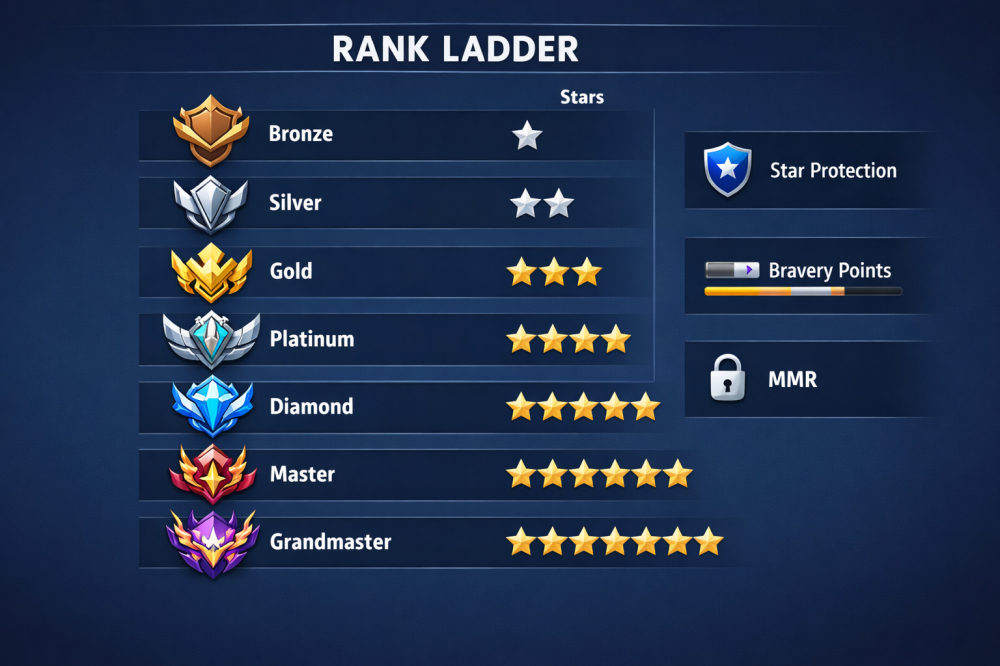
Every ranked game in Honor of Kings is built on two core metrics: your visible rank (Bronze through Grandmaster) and your hidden MMR. The matchmaking algorithm doesn't just grab ten nearby players and throw them into a lobby. It calculates, balances, and sometimes compromises. According to recent updates (active as of September 2026), the system uses a dual-weight model: your current rank influences about 60-70% of matchmaking decisions, while your performance score affects the remaining 30-40%. In plain terms, the game first finds players in your rank bracket, then adjusts for skill within that pool.
This is a shift from older systems that leaned heavily on MMR. Previously, a Diamond player with a high hidden score could be matched against Masters or Grandmasters because the system "knew" they could compete. Now, the game prioritizes rank badges first, so you rarely see a Diamond versus Grandmaster on paper. But this creates a new problem: the skill gap inside the same rank can be enormous. A fresh Diamond and a veteran who's been stuck there for 500 matches are treated as equals by the rank filter, even though their actual performance scores differ wildly.
### Why Your Matches Feel Unfair
That "same badge, different skill" issue is the root of most frustration. Consider a Diamond III lobby. You might have a rising star just promoted from Platinum, a veteran grinder with hundreds of matches, and a smurf on an alt account who's actually Grandmaster-level. All three appear as Diamond III on the loading screen. The algorithm tries to balance teams by distributing these skill types across both sides, but when the player pool is small or one team gets two smurfs, the match feels lopsided. This is why you sometimes dominate or get stomped even though the ranks look even.
The system's goal, as stated in official patch notes, is to make "the game intensity of each match more closely match players' perception of their rank." But in practice, the rank-first approach means you'll face opponents with vastly different true skill levels, all wearing the same badge. That's not a bug—it's a compromise the system makes to keep queue times short and matches frequent.
### Bots: The Invisible Fillers
Another reason matches feel off is the presence of bots. When the matchmaking system can't find enough real players in your rank bracket within a reasonable time, it fills slots with AI-controlled bots. This happens most often in low-rank solo queue (Bronze to Platinum), during late-night hours in any rank, for new accounts in their first 10-20 matches, and sometimes after consecutive losses as a "recovery" mechanic.
Bots are easy to spot once you know the signs: they never chat or ping, they pick beginner-friendly heroes like Arthur or Daji, they follow rigid item builds, they move in straight lines and ignore grass, and their profiles are often blank or inaccessible after the match. They follow predictable scripts every game.
Why does the game include bots? Two reasons: queue time reduction and new player protection. Without bots, low-rank queues during off-peak hours could take minutes, which hurts engagement. And a brand-new player who loses their first five matches against experienced humans is likely to quit. Bots provide a soft landing so newcomers can learn mechanics and earn early wins. The downside is transparency—the game doesn't flag bot matches, so players might think they're improving when they're actually beating AI.
### Aligning Your Rank and Hidden Rating
So how do you make the system work for you? The key is aligning your visible rank with your hidden MMR. When they're in sync, your climb feels normal—you win about half your games and slowly progress. When they're misaligned, you'll feel it: winning too easily (your MMR is higher than your rank) or facing brutal matches (your MMR is lower).
The goal isn't perfection; it's a small edge over many games. In a star-based ladder, you're "stuck" when your win rate hovers around 50%. If you consistently win 55-60%, you'll climb. If you drop to 45-49%, you'll fall. Your job is to improve your underlying skill signals—fewer deaths, better objective timing, smarter fights—so that your MMR rises. This, in turn, makes matchmaking treat you as a stronger player within your rank.
Remember, the system is measuring performance across many matches, not just today's win or loss. Short-term results are noisy—a teammate feeding can cost you a star even if you played well. But over time, consistent performance will adjust your hidden rating and make your matches feel fairer.
### The Takeaway
Honor of Kings' matchmaking isn't out to get you. It's a complex system balancing rank, skill, and queue times. By understanding the role of hidden MMR, you can stop blaming bad luck and start focusing on what you can control: your gameplay. Reduce deaths, secure objectives, and stay consistent. As your hidden rating climbs, so will your rank—and those unfair matches will become fewer and farther between.
📚 Related Guides
Mastering Honor of Kings Team Fights: Positioning and Teamwork Essentials
Learn the core principles of team fight positioning and teamwork in Honor of Kings to dominate ranked matches in 2026.
Mastering Honor of Kings Map Objectives: Tyrant and Overlord Guide
Learn when and how to secure Tyrant and Overlord buffs to dominate Honor of Kings matches.
How to Get Free Skins in Honor of Kings: The 2026 F2P Guide
Discover every legit way to earn free skins in Honor of Kings, from Dragon's Hoard to seasonal events, without spending a cent.
Mastering the Shadows: Honor of Kings Best Assassin Heroes Guide
Discover the top assassins in Honor of Kings as of September 2026, with tier rankings and expert tips for dominating the jungle.
Honor of Kings Tank Heroes: Front Line Guide for 2026
Discover the top tank heroes in Honor of Kings for 2026, their strengths, and how to dominate the front line.
Mastering the Mid Lane: Top Mages to Climb with in Honor of Kings (September 2026)
Discover the best mage picks for mid lane in Honor of Kings, with tips on wave control, roaming, and itemization to dominate the current meta.